

- Written by: Author
- March 16, 2026
- Comments: (0)
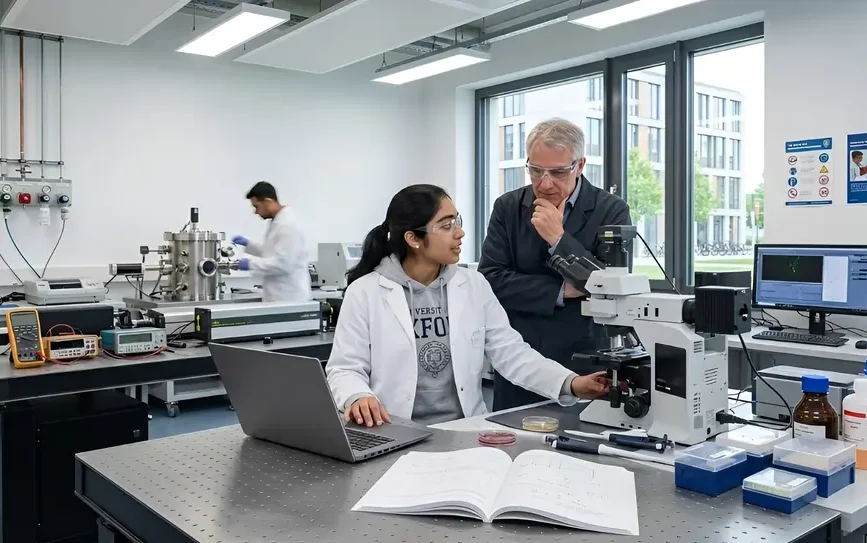
Germany is among the best places that international students may wish to study high-quality higher education and advanced research opportunities. People are all too used to traditional research universities in Germany, but they do not know much about the significant role played by Universities of Applied Sciences (Fachhochschulen). These are institutions which are oriented towards practice, industry partnership, and education that is career oriented.
In case you have plans to study in Germany and are considering advancing your studies to the doctorate level, it is imperative to have knowledge on how the system operates. Through StudyLead Consultants, students can be taken through the whole process of choosing the appropriate university, the process of acquiring study visa and doctoral career opportunities in Germany. Careful guidance and guidance will help would-be students to undertake the right steps in their education.
In this blog, we shall discuss the way Universities of Applied Sciences are run in Germany and how students could pursue a Doctorate (Dr.) degree using them.
Table of Contents
ToggleUnderstanding Universities of Applied Sciences in Germany
Universities of Applied Sciences are also called Fachhochschulen in German. They are institutions of higher learning that focus on practical research and industry oriented education. They are structured in a way that their programs equip the student to work in particular careers through integrating theory and practice.
Universities of Applied Sciences are marked by some of the following:
- Good working relationships with industries and companies.
- Dwelling on practical skills and practical research.
- Reduced classes and interactive pedagogy.
- Internship and project-based learning.
Popular courses studied in these universities are:
- Engineering
- Business and Management
- Information Technology
- Design and Media
- Social Sciences
Graduates in these universities are very marketable in the workforce due to their pragmatic nature.
Can Universities of Applied Sciences Offer Doctorate Degrees?
Universities of Applied Sciences were not allowed to issue doctoral degrees on their own in Germany. Traditional research universities (Universitaten) mostly provided doctorates.
Nevertheless, the system has been changed during last ten years. Nowadays, the number of Universities of Applied Sciences, which are engaged in applied research and doctoral supervising, is growing.
There are two predominant ways in which the students out of the said institutions can get a doctorate:
- Commonly known as cooperative doctorate programs, these are educational programs designed to combine the practical experience of a doctorate student with the academic study of a researcher (Mazzei, 2018).
- Doctoral Privileges to Chosen Applied Universities.
Cooperative Doctorate Programs
The cooperative doctoral programs are the most widespread method of students of the Universities of Applied Sciences obtaining a doctorate.
In this model:
- Professors in a University of Applied Sciences and a conventional university supervise a student.
- The research project can be done either in the university of applied sciences or through industry partners.
- The traditional university is the awarding institution of the official doctoral degree.
The system enables students to balance research and academic knowledge and is therefore a rare and worthwhile research experience.
Cooperative doctorates are specifically frequent in such areas as:
- Engineering
- Applied sciences
- Computer science
- Environmental technology
- Business innovation
Universities of Applied Sciences with Doctoral Rights
Over the past years, a few states of Germany have begun giving University of Applied Sciences limited doctoral rights.
With these developments, such institutions are now allowed to grant doctorates in certain fields of research provided that they satisfy strict specifications, i.e.:
- Strong research output
- Experienced doctorally supervised qualified professors.
- Research centers that are well established.
Some of the states such as Hesse, and North Rhine-Westphalia have implemented policies that enable some applied science institutions to carry out independent supervision and grant doctorates in specialized disciplines.
This development may be seen as the increasing significance of applied research in the field of higher education in Germany, although it remains rather limited.
Requirements for Doctoral Admission
The general admission qualifications to doctoral programs associated with Universities of Applied Sciences include:
- A master degree and good performance in school.
- A pertinent educational qualification with respect to the field of the research.
- A research proposal
- An agreement with a professor as a supervisor.
- Evidence of language skill (either English or German).
Some doctoral programs that are cooperative also require the student to enroll at the university in which the doctorate is earned.
Funding Opportunities for Doctoral Students
Germany has various funding opportunities to doctoral students, and these include:
- Research positions in universities.
- Research projects funded by industries.
- Government research grants
- Organizational and Foundation scholarships.
A large number of doctoral students take up the role of research assistants, which gives them an opportunity to receive a salary as they work on their doctoral studies.
Final Thoughts
The role of Universities of Applied sciences in the higher education and research environment in Germany is becoming an increasingly significant phenomenon. Though the traditional universities have always been known to grant doctoral degrees, the institutions of applied sciences are becoming increasingly significant with the help of the cooperative doctoral programs and the new rights to a doctoral degree.
In the event that you are intending to study or take a doctorate in Germany, StudyLead Consultants will assist you in searching the best universities to attend, preparing a good application and also take you through the whole admission and visa process. So start your journey.