

- Written by: Author
- November 14, 2025
- Comments: (0)

Most of the asian students don’t meet the criteria for the study of the entry tests of the UK universities.
It happens as countries have different levels of education, which may not meet the standards of the UK university that you’re willing to get into. This is where the foundation program in the UK helps you.
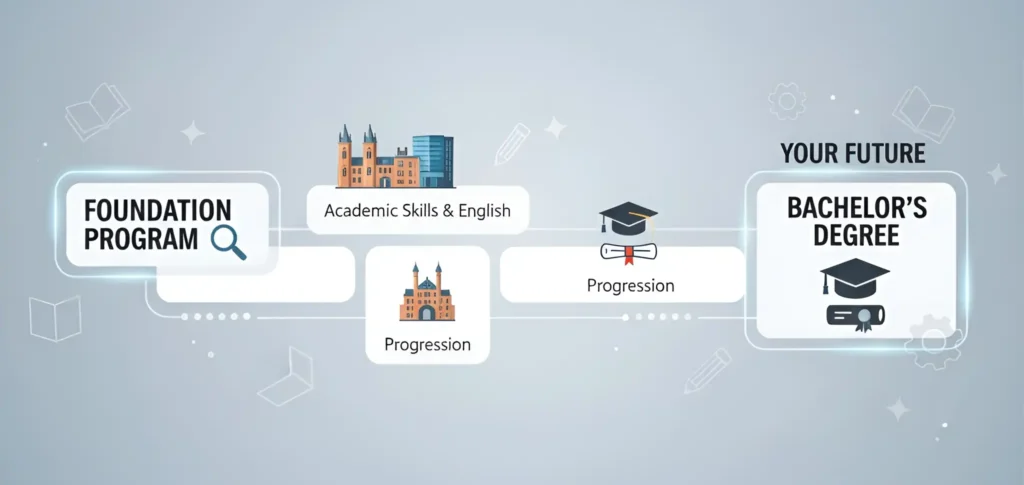
It’s a preparatory program that prepares you for the bachelor’s degree by teaching you the foundational aspects of your chosen course, including subjects, study skills, and English proficiency, making you ready to get into your dream university easily. Read this post to explore foundation programs in the UK and determine if they’re worth it.
Table of Contents
ToggleWhat is a Foundation Program in the UK?
It is a one-year degree designed for international students before undergraduate study. When an international student fails to meet the educational requirements set by a UK university to obtain a bachelor’s degree, this foundation program prepares them to join their dream universities with ease.
It is useful for students with a lower level of education, fewer than 13 years, in China, India, Bangladesh, and the Middle East. It ensures that the students meet the standards of the UK university by providing them with the English language, the subjects of the course chosen, critical thinking, research, writing, and whatever else is required by the university.
Types of Foundation Programs
UK offers a number of different foundation programs among which are Business and Economics, Science and Medicine, Engineering and Technology, Arts and Humanities and Law and Social Sciences.
Business and Economics:
Prepares you with a degree in global business, management, or finance.
Science and Medicine:
It deals with life sciences, biomedical and health related topics.
Engineering and Technology:
Directs to mechanical, civil or electrical engineering degrees.
Arts and Humanities:
Provides entry to the programs of art, design, media, or literature.
Law and Social Sciences:
Suits law, sociology, psychology or international relations studies.
Benefits Of Studying in Foundation Programs
Foundation programs ensure that you’re ready for your chosen course and do well in it.
- Foundation programs teach essential skills for studying at a UK university.
- They help students improve basic language abilities needed for university.
- The course bridges the gap between school and university studies.
- Modular courses allow students to aim for higher grades.
- Students finish the program by taking exams.
- It gives time to adjust to life in the UK.
- You can make friends and enjoy a new cultural experience.
- Many top UK universities offer foundation programs in various subjects.
- Completing a foundation course allows you to continue higher education.
- It helps explore courses and make career decisions.
- A foundation program supports personal growth and self-discovery.
Subjects You Can Study in Foundation Programs
These are the subjects that you study in the foundation programs in the United Kingdom.

- Education
- Social studies
- Biological sciences
- Sports
- Business
Is a Foundation Program Equivalent to Other Degrees?
No, it’s not, as it’s a preparatory one-year degree that is focused only on making you able to study your course better. It’s a standard qualification that helps you transition to higher education. It just bridges the gap between your qualifications and the standards of your university of interest.
Who Benefits from a Foundation Course?
The ideal students for the foundation programs are those who took a break from their education or whose qualifications do not meet the admission requirements to their dream university. It helps students to resume an academic career successfully and also allows interaction with teenage and mature students alike.
You meet people with similar interests and qualifications, learn from one another, and improve your self-esteem, which helps you a lot in higher education ahead.
Basic Requirements for a Foundation Program
The requirements of a foundation degree depend on the course you’re applying for. However, these are usually the basic requirements that you need to meet.
- Open to students without formal qualifications
- No standard undergraduate entry requirements
- Secondary education completion is often required
- Maths and English are usually needed
- Work experience or vocational qualifications may be requested
- Passion and relevant experience are considered in admissions
- Financial support available (loans or bursaries)
- Linked to professional degrees and supported by tutors
- Students learn university-level expectations and standards
- Foundation students enjoy full campus and student benefits
Documents Needed To Enrol in the Foundation Program In The UK
To prove your eligibility for Foundation programs, you need to provide these documents.
- Valid passport
- Statement of purpose
- Educational transcripts
- Recommendation letter
- Diploma of High School
- An IELTS 5-plus score in proof of English language proficiency.
- Admission offer letter for visa application

Universities Which Offer Foundation Courses In The UK
You can take the foundation courses from many universities in the UK, including Edinburgh, Leeds, University of Manchester, Salford, Warwick, the University of London, King’s College London and Southampton.
1. University of Manchester
The University of Manchester offers integrated foundation years in science, engineering, and biological sciences right on campus. Students gain full access to facilities and progress directly to over 50 undergraduate degrees after passing.
2. University of Salford
The University of Salford offers foundation programs that build English and subject skills for permission to study a degree program. Successful students receive guaranteed places on more than 100 undergraduate courses.
3. University of Warwick
Law and physics are among the 12 pathways available in Warwick’s one-year foundation program. It includes personal tutor support and conditional offers for Warwick degree progression.
4. University of Edinburgh
The University of Edinburgh combines academic, English, and study skills in its foundation program. High pass rates lead to automatic entry into honours degrees in various fields.
5. University of Sheffield
Engineers, scientists, and business students can take foundation courses at Sheffield’s International College. Students use all campus facilities and move straight to year one.
6. University of Leeds
The University of Leeds offers 150 degrees through its International Foundation Year program. No additional application is needed for direct progression after completion.
7. University of London
The University of London provides the International Foundation Program at centres worldwide, online or in person. The certificate opens doors to over 100 UK universities for degree entry.
8. University of Southampton
Even the most famous, Southampton University, a dream university for many, offer the foundation courses in fields like humanities, life sciences, and business. Passing guarantees progression to 19 subject areas, with a Malaysia option.
9. King’s College London
King’s College London offers the King’s International Foundation with four pathways in the heart of the city. It offers conditional degree offers and scholarships for nearly all programs.
How to Apply for Foundation Courses?
If you meet the eligibility criteria of the foundation programs, these are the steps that you need to follow to apply for them based on your course.
1. Choose Your Course
Choose a foundation program that matches your future plans and your interests. Examine the lessons, the university facilities, and the town or city location.
2. Submit Your Application
Send your form directly to the university or go through UCAS to start the process. Gather school grades, English test results like IELTS, and any extra papers they need right away.
3. Interview or Assessment
A few courses ask for a quick chat or an easy test to make sure the program suits you. Get ready to talk about your interests and show simple skills in a calm way.
4. Offer and Acceptance
The university will send a letter with a yes, sometimes with small tasks to complete first. Complete those tasks, such as a set English score, to secure your place fully.
5. Visa and Arrival Preparations
Once you accept the offer, apply for a UK student visa with the paperwork. Book housing, sort travel plans, and look at university help for new students.
6. Visa and Arrival Preparations
Once they accept your offer, grab all your papers and apply for the UK student visa straight away. It’s simple and keeps everything smooth for entering and studying. Next, book your flight, sort out a place to live, and look up the university’s free help, like the student desk or welcome events. All done, no worries.
7. Housing and Student Support
In the case of some universities, there is on-campus accommodation that is provided in single rooms, shared flats, and studios. Other assistance, such as orientation, cultural workshops, and student advisors, is also offered.
8. Scholarships and Financial Aid
The foundation programs in the UK have few scholarships compared to other undergraduate degrees. Others are paying part of the tuition or giving discounts and other benefits depending on academic excellence or economic necessity.
9. Living Expenses in the UK
The UK varies in terms of the city cost of living. The Northern cities are relatively cheaper than others. Other expenses also include accommodation, food, transport, and other personal needs that you may need. Colleges also include good financial guidance and can assist students in securing a part-time job to cover their bills.
Final Words
A foundation program in the UK is a one-year degree that prepares you for the education standards of your chosen course and the university. This course is designed for students who have studied for fewer than 13 years in their home country, which doesn’t meet the minimum education standards of UK universities. By taking this program, you improve your English, study skills, research, writing, and other necessary skills that help you become capable of the university you want to get into and do well there.
There are many universities in the UK offering this course with different fees and requirements that you need to meet. By exploring the foundation programs in the UK and researching each, you can find a suitable one for yourself.