

- Written by: Author
- January 23, 2026
- Comments: (0)
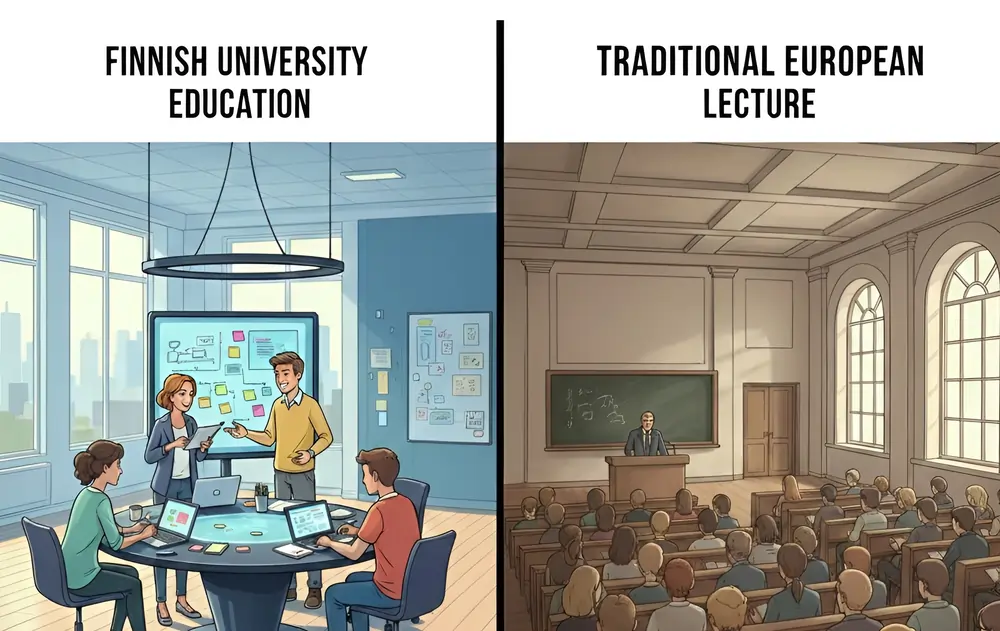
The study destinations in Europe are quite a number and therefore why should Finland be the number of choice when students are comparing their destinations? It is not just in rankings or campus facilities, but the way learning is structured, the evaluation of students and the process by which universities relate learning and practical skills.
The Finnish universities educational system has been characterised as organised, learner-centric, and long-term competence oriented instead of short-term memorisation. Studylead Consultants can assist you in going through the program fit and process preparation of your application which would ensure you do this right.
This blog elaborates on the unique features of the Finnish Universities, in terms of a handy Finland vs Europe education system comparison, and explains to people what they usually mean by saying why Finnish Universities are better.
Table of Contents
ToggleFinland vs Europe: a quick comparison
Area | Finnish Universities (Common Pattern) | Many European Countries (Common Pattern) |
Learning approach | Student-centered, discussion + projects | Often more lecture-heavy in some systems |
Assessment | Continuous coursework + assignments | More exam-focused in many programs |
Academic culture | Trust-based, independent learning | Often more formal and hierarchical |
Support services | Integrated student support | Varies widely by country/institution |
Practical relevance | Strong applied track (UAS) | Strong in some places, less consistent elsewhere |
Note: Europe is heterogeneous; the table shows the differences that are likely to exist, not the general rules.
1. Student-centered learning is built into course design
Among the significant variations in the Finnish universities education system is that the students are supposed to be active. Training usually occurs during discussion, reading research and practicals, and not by lectures only.
Common teaching methods include:
- The assignments every week or every module.
- Program-dependent mid-course tests or quizzes.
- Report, research papers, and portfolios.
- Team projects that have grading rubrics.
This does not imply that study is an easy thing. It implies that performance is developed by regular work, which is one of the main reasons why some students claim that Finnish universities are the best ones to develop skills.
3. A trust-based academic culture shapes daily university life
The Finnish academic culture presupposes that students are adults who are responsible. This credibility-based practice affects the classroom behavior and expectations.
The experience of students, which is likely to be the same:
- Strong academic ethical standards.
- Autonomous work as an obligatory condition.
- Informal teacher-student communication.
- Time planning and focusing on self-management.

It is a significant component of the education system of Finnish universities in that students have been trained to behave like professionals- organised, responsible, and consistent.
4. Clear degree structure and transparent learning outcomes
The Finnish universities tend to give a clear course description, learning outcomes and credit frameworks. This openness makes international students know precisely what is required.
Some of the practical aspects that the students observe include:
- Developed module outlines and assessment criteria.
- Clear credit mechanisms and labor expectations.
- Essential advice on the thesis planning (at least at the master level).
These are some unique features of Finnish universities which can simplify the process of planning in contrast to systems where the expectations of a course are not well-documented.
5. Student support is often integrated, not separate
The support systems differ in Europe yet Finland has a reputation of making student support part of the university life. It can also be of great assistance especially to international students used to a new academic culture.
Support areas often include:
- Academic counseling and academic planning.
- Employability advice and career advice.
- Onboarding and support of international students.
- Campus organizations, associations and peer groups.

This adds to the perception of why Finnish universities are better particularly to students who prefer being directed whilst learning on their own.
Final thoughts
The Finnish university education system often feels different because it combine This difference in the Finnish universities education system is common since it integrates student centred learning, constant evaluation, autonomous academic ethos, and clear program design.
These unique features of Finnish universities underlie the reason why students compare Finland vs Europe education system and arrive at the conclusion about the reason why Finnish universities are better to the learners who are inclined to the practical and skills-oriented development and to the organized expectations.
In case you need assistance with the selection of a university, knowledge of entry requirements, and creation of a full application, contact Studylead Consultants and make a consultation to develop a clear study plan.